

First Impressions and Onboarding
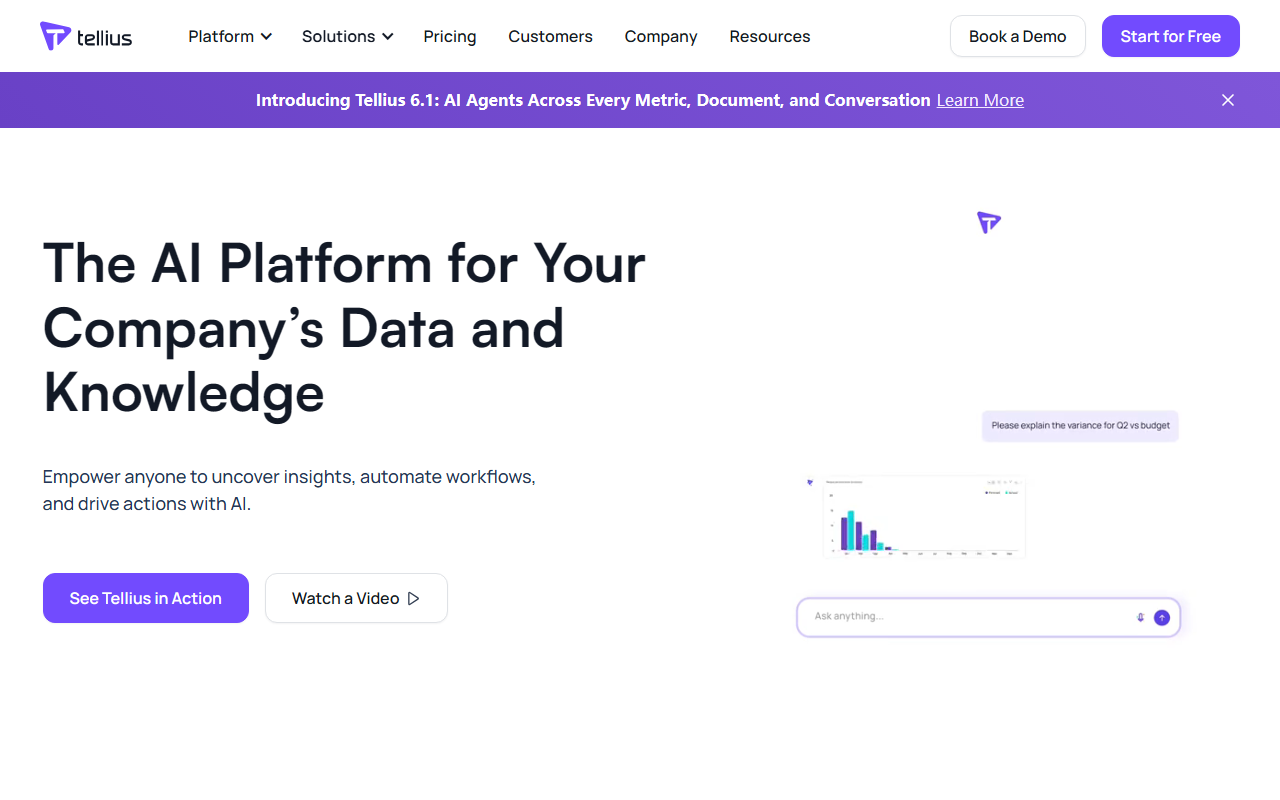
When I first visited Tellius, the landing page instantly communicated its core value: "Always-On Intelligence." The interface is clean and enterprise-focused, with clear navigation to Solutions, Pricing, Customers, and a prominent "Start for Free" button. Upon signing up for the free tier—which offers a limited but functional preview—I was guided through a brief onboarding that connected to sample data. The dashboard immediately showed two distinct modes: Proactive (for scheduled missions) and Exploration (for ad-hoc queries). I was impressed by how quickly the AI, named Kaiya, started analyzing data without requiring complex setup. The system automatically surfaced a "Weekly Revenue Analysis" mission and displayed a sample output: a PDF briefing with 12 insights and 3 recommendations, ready to share.
Core Features and Workflows
Tellius is built around what it calls "Agentic Analytics." At its heart is Kaiya, an AI agent that understands business context, not just keywords. I tested the exploration mode by typing "Why did APAC revenue drop last week?" The response was remarkably specific: the AI identified three root causes—Japan Golden Week holiday, a delayed Sony deal, and Australian shipping delays—each with a percentage impact. This is far beyond what typical NLQ tools deliver. The proactive mode allows you to define "Missions" that continuously monitor your data and deliver finished outputs (PowerPoint, PDF, email, Slack) on a schedule. I set up a simple "Pipeline Health Check" mission and received an alert the next morning with an attached memo. The system also features specialized agents for functions like Revenue Anomaly Monitoring and Churn Risk Detection. All data sources—CRM, financials, call transcripts—are unified in a semantic layer with citations, eliminating silos.
Target Audience and Competitive Standing
Tellius is clearly designed for enterprise teams that require deep, verticalized analytics. It excels where dashboards and generic LLMs fall short: proactive root cause analysis and polished, presentation-ready artifacts. In the competitive landscape, it stands apart from tools like Tableau or Power BI, which rely on manual dashboard creation and interpretation. ThoughtSpot offers similar natural language query, but Tellius adds the "agentic" layer that works while you sleep. The tool is particularly suited for RevOps, pharmaceutical, CPG, and FP&A teams—industries where understanding "why" a metric changed is as important as the change itself. According to the site, Tellius ranked #1 in the Dresner Agentic AI Market Study, and Novo Nordisk reported 88% time savings. However, pricing is not publicly listed beyond the free tier—you must book a demo for enterprise plans—which may frustrate smaller teams. The free tier is generous enough for a trial but limited in data volume.
Strengths, Limitations, and Recommendation
Strengths: The biggest win is the shift from reactive to proactive analytics. Tellius doesn't just answer questions; it delivers finished briefings before you ask. The root cause analysis is genuinely useful, showing not just what changed but why, with ranked drivers. The integration across data sources is seamless, and the output quality (PDFs, PPTs, memos) saves hours of manual work. Limitations: The tool is enterprise-heavy; small businesses may find the setup overhead and cost prohibitive. The free tier's data limits are restrictive, and without transparent pricing, budget planning is hard. Additionally, the agentic missions require good data hygiene to deliver accurate insights—garbage in, garbage out. Recommendation: I recommend Tellius for mid-to-large organizations that deal with complex, multi-source data and need executive-ready insights without manual cleanup. If you are a small startup with simple data, consider lighter options like Google Looker Studio or basic LLM chat. But for anyone tired of dashboards that tell you what happened without explaining why, Tellius is worth a serious look. Visit Tellius at https://tellius.com/ to explore it yourself.













Comments