

First Impressions and Onboarding
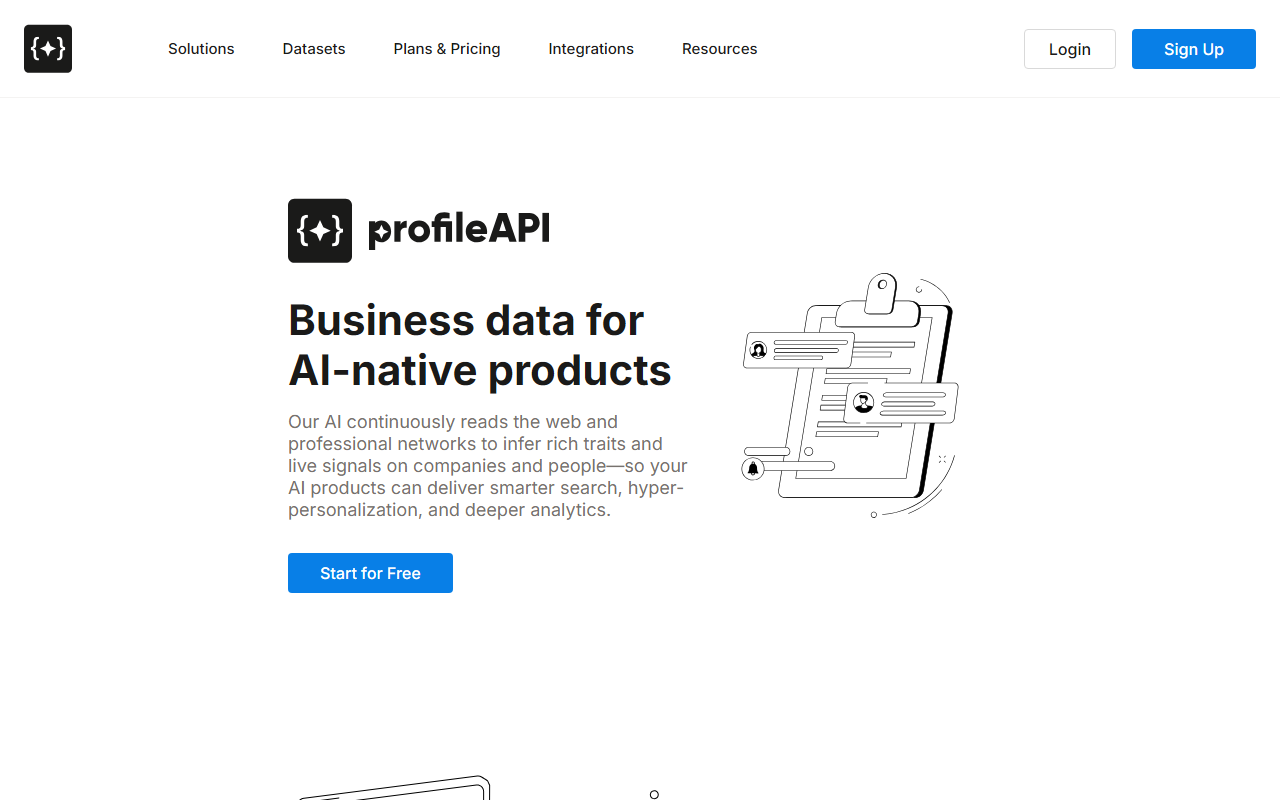
Upon visiting truebase.io, I was struck by the clean, developer-first design. The hero section reads “Business data for AI-first GTM” with a subline “Prompt to results in seconds, using fewer tokens.” This immediately signals the product’s niche: it’s built for coding agents and AI‑native workflows, not traditional sales prospecting. The navigation bar lists Products (MCP Server, API, Data Feeds, GTM Engineering Services), Solutions, and Datasets. The “Get Started” button leads to a sign‑up page, but I didn’t see a free trial or sandbox without registration. The “Plans & Pricing” link in the footer is present, but no specific tiers or prices are visible before logging in — a notable lack of transparency for quick evaluation. The documentation link suggests a standard API onboarding flow with authentication keys and endpoint references.
Core Functionality and Technical Details
Truebase’s core is the profileAPI, which provides company, person, and contact data. The site boasts “1+ Billion AI-Inferred Traits & Signals” derived from continuous analysis of public web and professional sources. It covers 15M+ companies, 500M+ people, and 1.2B+ emails and phones. The API can enrich profiles, search for accounts and buyers, prioritize leads, personalize outreach, trigger workflows from changing context, identify people from emails/phones, and discover contact info. What sets this apart is its delivery mechanism: alongside standard REST API and data feeds, it offers an MCP Server — likely compatible with Anthropic’s Model Context Protocol — enabling AI agents to fetch structured context without bloating prompts. The “GTM Engineering” service implies custom integrations and consulting for teams that need tailored pipelines. This focus on low‑token context retrieval is a clear differentiator for teams running LLM‑based agents on platforms like GitHub Copilot, Claude, or custom GPTs.
Market Position and Pricing
Truebase competes with established business data providers such as Apollo.io, ZoomInfo, and Clearbit. However, it differentiates by targeting AI‑first teams and agent‑driven workflows, rather than manual prospecting UIs. The MCP Server integration is ahead of most competitors, who still prioritise CRM syncs and browser extensions. Pricing is not publicly listed — the website only links to a “Plans & Pricing” page that requires login. This is a real limitation for small teams or freelancers who need cost estimates before committing. Given the lack of published numbers, I suspect enterprise custom pricing is the norm. Strengths include fresh, AI‑inferred signals, broad dataset coverage, and explicit support for agent token efficiency. Limitations include pricing opacity, no visible free tier or trial, and a developer‑only interface that may alienate less technical GTM operators.
Who Should Use Truebase (and Who Should Look Elsewhere)
Truebase is best suited for GTM engineering teams, AI agent developers, and platform builders who need to inject live business context into automated workflows. It excels where token budgets matter and where raw data (rather than polished UI) is the primary deliverable. Early‑stage startups with in‑house dev resources or mid‑market firms building custom sales automation will find real value. Conversely, solo operators or small teams looking for an out‑of‑the‑box prospecting tool with a rich GUI should stick with Apollo, ZoomInfo, or Lusha. The lack of transparent pricing also makes it challenging for budget‑constrained teams to evaluate without a sales conversation. If your stack already includes AI agents and you prioritise reduced LLM costs, Truebase deserves a close look.
Visit Truebase at https://truebase.io/ to explore it yourself.













Comments