

First Impressions and Onboarding
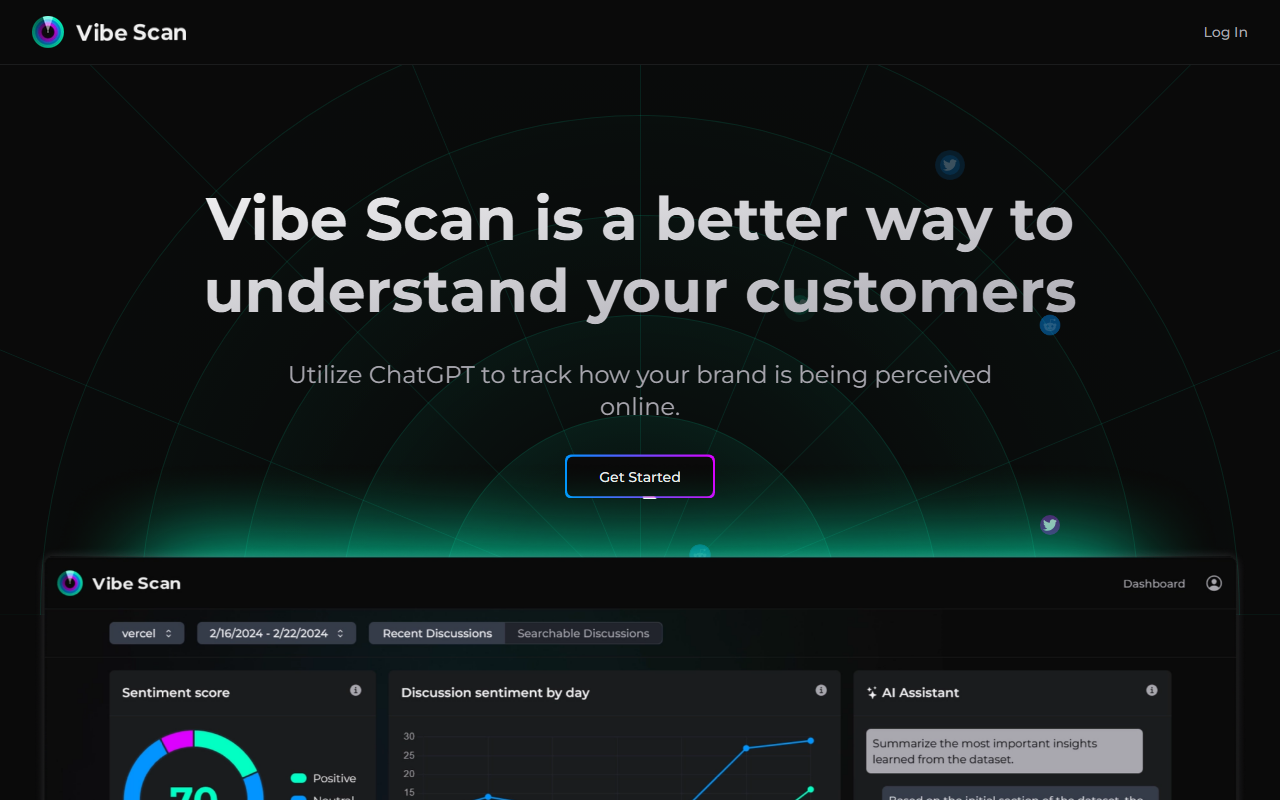
Upon visiting the Vibe Scan website, the first thing I noticed was its clean, minimalist design. The homepage immediately pitches a clear value proposition: a better way to understand your customers using ChatGPT-powered sentiment analysis. The onboarding flow is straightforward — a single "Get Started" button invites you to create a dashboard for your brand. I tested the free tier by entering a brand name and was prompted to log in (via email or Google). Once inside, the dashboard presents a sentiment score (0-100 scale) and a breakdown of positive, neutral, and negative discussions. The initial scan took about 30 seconds, which felt reasonable. The interface is intuitive, though some advanced features like filtering and the AI assistant are only unlocked after a full setup.
Features and Technology
Vibe Scan relies on ChatGPT to emulate how potential customers research a brand online. It scours the internet for discussions — likely drawing from forums, social media, review sites, and blogs — and aggregates them into a single dashboard. Two viewing modes are available: Searchable-View, which lists discussions sorted by relevance, and Recent-View, which shows conversations from the past week. The sentiment analysis is divided into three categories (positive, neutral, negative) and updates weekly. I found the “Important discussions” table particularly useful; it lists each analyzed discussion with source and excerpt, allowing you to filter by keyword or source type. A personal AI assistant, powered by ChatGPT, lets you ask questions like "What are my biggest reputation risks?" and receive context-aware insights. During my test, the assistant provided a concise summary of the top three negative threads and suggested response strategies. The tool also tracks competitor sentiment scores, though I found limited detail on how those scores are calculated.
Pricing and Limitations
Pricing is not publicly listed on the website — you must sign up and likely book a demo to see plans. This lack of transparency is a drawback for budget-conscious teams. More critically, Vibe Scan only performs a weekly scan. For brands that need real-time alerts (e.g., during a PR crisis), this is a significant limitation. The free tier offers only one brand dashboard and limited historical data. Additionally, the tool does not currently integrate with social media management platforms like Hootsuite or Sprout Social. Compared to established competitors like Brandwatch (which offers real-time monitoring and deeper analytics) or Mentionlytics (which includes social listening across more sources), Vibe Scan feels lean — but that simplicity might be exactly what small teams need.
Who Should Use Vibe Scan?
Vibe Scan is best suited for small to mid-size businesses that want a low-effort, AI-driven overview of their online reputation without drowning in data. The personal AI assistant makes interpreting sentiment easy for non-analysts. Marketing managers, startup founders, and solo entrepreneurs will appreciate the weekly digest format and competitor tracking. However, enterprises or agencies requiring real-time alerts, multi-brand dashboards, or deep data exports should look elsewhere. Vibe Scan is a promising entry in the AI reading space — it simplifies sentiment analysis but currently lacks the speed and breadth of more mature competitors. If you're just starting to monitor brand perception and want an AI assistant to guide you, this tool is worth a trial. Visit Vibe Scan at https://vibe-scan.com/ to explore it yourself.













Comments