
First Look and Onboarding
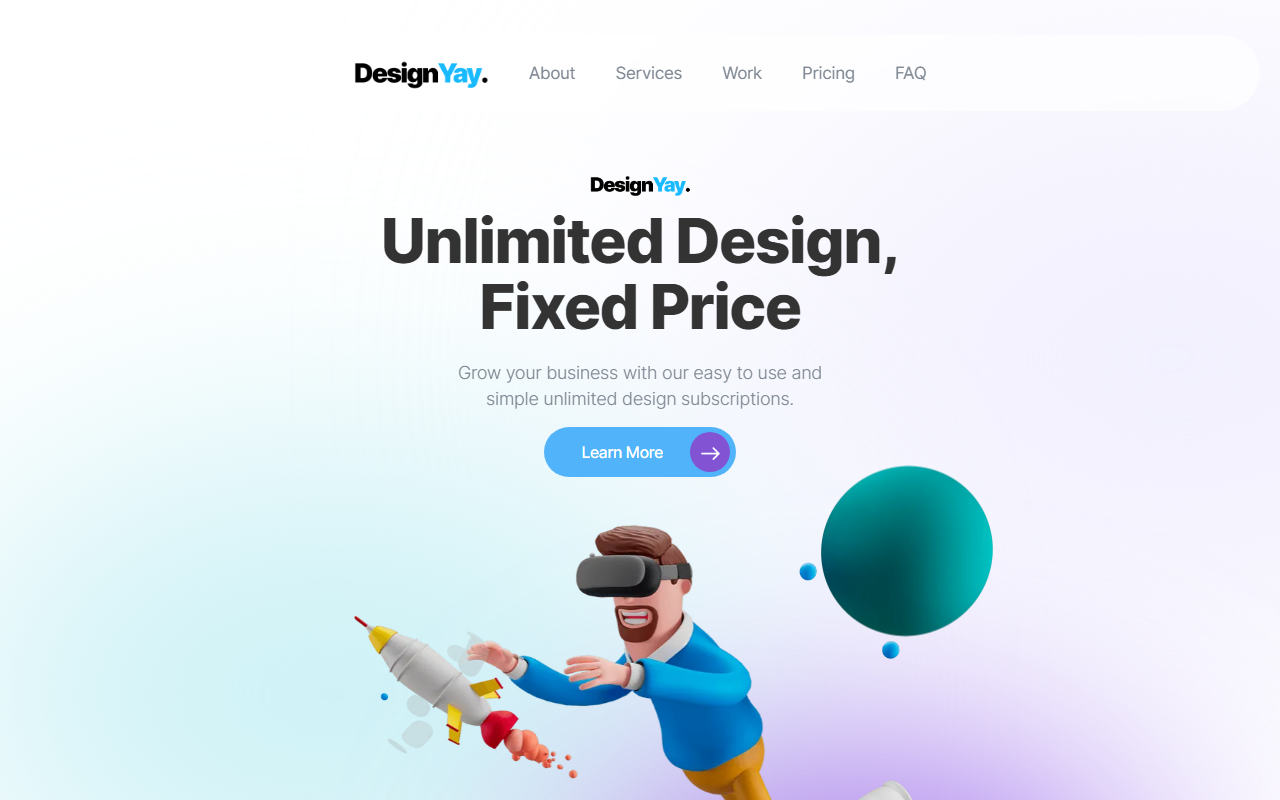
Upon visiting the DesignYay website, I was greeted by a clean, modern interface that immediately emphasizes the core value proposition: unlimited designs for one fixed price. The homepage leads with a large headline—'Unlimited Design, Fixed Price'—and a prominent call-to-action to learn more. The layout is straightforward, with sections that scroll through the company's promise of replacing freelancers and agencies, a showcase of past work, and pricing tiers. I noticed the navigation is minimal, focusing on 'Home,' 'Our Work,' 'Pricing,' and 'Contact.' The onboarding flow is simple: you create an account, submit unlimited design requests, receive deliverables with revisions, and can cancel or pause anytime. There is no software to install; it's all request-based via a dashboard. When testing the free tier (first month is free for new subscribers), I observed that the sign-up process requires basic business information and a payment method, but the first month has no charge. The dashboard itself is not publicly visible on the site, but the process appears to rely on a ticketing system where you send briefs and get designs back within a stated turnaround time (though exact turnaround isn't specified upfront).
How the Subscription Model Works
DesignYay positions itself as a hybrid unlimited design agency that combines human designers with AI artwork generation. The 'Ultimate' plan explicitly includes unlimited AI artwork, suggesting integration of generative AI tools alongside human review. The workflow is straightforward: you submit requests, the team works on them, and you receive files with unlimited revisions until satisfied. The site lists four steps: create account, submit designs, get deliverables, cancel anytime. This is essentially a design-as-a-service model, similar to competitors like Design Pickle or Kimp, but DesignYay emphasizes AI capabilities as a differentiator. In my assessment, the AI part likely refers to using tools like Midjourney or DALL-E to generate initial concepts or artwork, which are then refined by human designers. However, the website does not disclose which specific AI models or technologies are used. The portfolio includes examples like UI/UX redesigns for JCB Tools, an arcade site for 8 Bit Arcade, and branding for BioWave. These appear to be primarily human-crafted, with AI possibly speeding up asset generation. Notably, the site uses generic template screenshots (e.g., 'Sapiens Webflow Template') for some case studies, which reduces confidence in the originality of every project.
Pricing and Value
DesignYay offers two main subscription plans: the Pro Plan at $2,950/month and the Ultimate Plan at $2,999/month. The Pro Plan covers unlimited requests and unlimited brands, while the Ultimate adds unlimited AI artwork. There is also a 'Special Projects' option with an undisclosed price and an 'Enterprise' package at $999 that appears to be a one-time website design service (not a subscription). Compared to competitors like Kimp (starting around $599/month for graphic design) or Design Pickle ($995/month for a dedicated designer), DesignYay's pricing is significantly higher. The justification seems to be unlimited brands and multiple users, but the $50 difference between Pro and Ultimate is negligible. A genuine strength is the flat fee and cancellation flexibility—no minimum commitment and pause/cancel anytime. However, a real limitation is the lack of transparency: there is no information about turnaround times, the number of designers assigned to an account, or the quality guarantee. The portfolio images are reused and generic, which raises questions about the actual depth of work. Additionally, the AI artwork feature is vague; without concrete examples or model details, it's unclear how much value it adds. For small businesses on a tight budget, this price point is likely prohibitive. For larger companies needing a steady stream of design work without hiring a full-time team, it could be a viable option—especially if the free first month helps test the waters.
Final Verdict: DesignYay is best suited for established businesses or agencies that need high-volume design work across multiple brands and are willing to pay a premium for a flexible, subscription-based model. The inclusion of AI artwork is a nice bonus, but competitors offer similar services at lower prices. I would recommend trying the free first month to evaluate the speed and quality of deliverables before committing to a long-term plan. If your needs are simpler or more budget-conscious, look at alternatives like Kimp or even freelance platforms.
Visit DesignYay at https://designyay.com/ to explore it yourself.













Comments