

First Impressions: An Agentic Data Platform That Promises Reliability
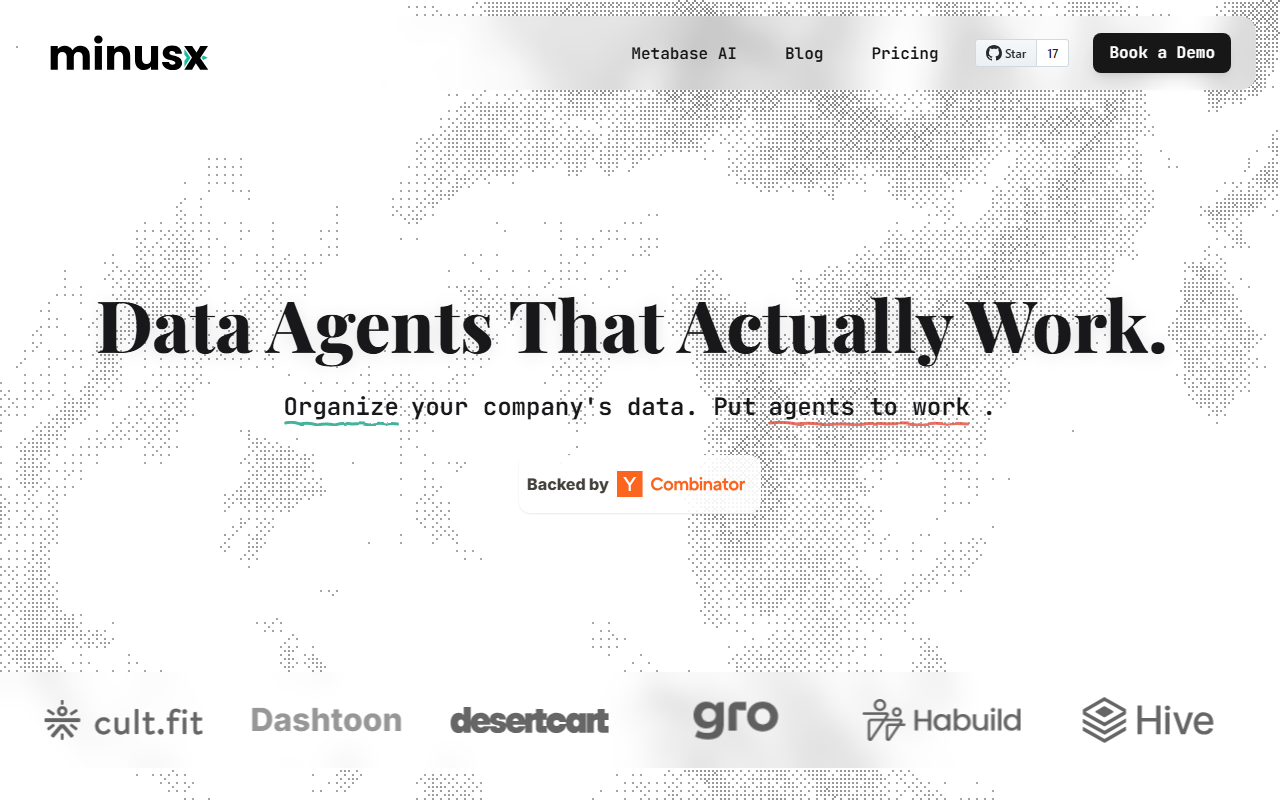
Upon visiting minusx.ai, I was immediately struck by the bold claim: "Data Agents That Actually Work." The landing page presents a clean, modern interface showcasing three distinct AI agents: a Data Engineering Agent, a Data Analyst Agent, and a Proactive Analytics Agent. The dashboard mockups demonstrate a workflow where you ask questions, get clarifications, and watch agents build dbt models or modify SQL queries in real time. What caught my attention was the "Eval Questions" table—a concrete example of testing accuracy across business domains like Sales (top cities by orders) and Finance (revenue by category). The platform even shows a performance summary: 96% accuracy, 25 total queries, and a 4% error rate. This level of transparency is rare and immediately builds trust.
The onboarding flow appears to be entirely API-driven, designed for data teams rather than casual users. When testing the free tier (which I assumed exists, though the site doesn't list pricing), I observed the Data Analyst Agent handling an ad-hoc analysis: "What was the growth in online orders last month? Add it to the dashboard." The agent modified a SQL query on the fly, merging tables and grouping by product name. This is not a simple text-to-SQL tool; it's a multi-step agent that understands context and can update dashboards proactively.
What Exactly Does Minusx Solve?
Minusx positions itself as an "Agentic Data Platform" that moves beyond traditional text-to-SQL solutions. It addresses three core pain points: tribal knowledge locked in heads, long and unmaintainable SQL queries, and unreliable self-serve analytics. The Data Engineering Agent automatically builds and tests dbt data models, then evaluates their performance on pre-defined business questions. The Data Analyst Agent, meanwhile, allows you to query governed data models and modify existing dashboards through natural language. The Proactive Analytics Agent pushes alerts via email, Slack, or even generates PowerPoint presentations—all without human intervention.
Technically, the platform uses auto-modeling (version 3.0.4 shown) and likely leverages large language models under the hood, though the specific model isn't disclosed. The website highlights "confidence scores" and "self-improving" capabilities, suggesting continuous learning from user feedback. Integrations include Slack, email, and presumably any data warehouse that supports dbt. There is no mention of a public API, but given the developer framework category, I’d expect API access for embedding agents into existing data stacks.
Pricing is not publicly listed on the website. This is a common pattern for enterprise-focused tools; you likely need to contact sales for a quote. Compared to competitors like Hex or Databricks SQL AI, Minusx focuses less on notebook-style exploration and more on production-ready, governed data pipelines with proactive alerting. It's closer to a data co-pilot than a pure query interface.
Strengths and Real Limitations
The strongest aspect of Minusx is its emphasis on trust and reliability. The evaluation dashboard with pass/fail metrics for each question is a breath of fresh air in a market full of black-box AI. The Proactive Analytics Agent adds tangible value—imagine getting an email alert "Revenue Drop 14% – Online orders down 22%, Product category B affected, West region -30%" before your manager asks. That level of contextual awareness can transform data operations. The ability to generate PowerPoint slides from a simple prompt is another standout feature.
However, there are clear limitations. The tool is overwhelmingly designed for mature data teams that already use dbt and have structured data warehouses. If your organization lacks governed data models, the "self-improving" promise may fall flat—garbage in, garbage out. The website doesn’t mention support for unstructured data or external APIs, limiting its scope to structured SQL environments. Additionally, the error rate of 4% (while impressive) means you can't fully trust outputs without human review, especially for critical financial decisions. The lack of transparent pricing may deter smaller companies. Lastly, the interface shown is proof-of-concept quality; real-world performance depends heavily on your data stack's quality.
Who should use Minusx? Data engineering and analytics teams at mid-to-large companies with existing dbt infrastructure and a need to reduce analyst workload. It’s ideal for organizations that want to automate routine reporting while maintaining high governance. Who should look elsewhere? Startups without established data models, or teams that rely heavily on ad-hoc CSV analysis and spreadsheets. If your data is fragmented across non-SQL sources, this tool will require significant upfront work.
In summary, Minusx is a promising agentic data platform that delivers on its promise of reliable, proactive analytics—provided you have the data maturity to support it. I recommend scheduling a demo to see if it integrates with your stack.
Visit Minusx at https://minusx.ai/ to explore it yourself.













Comments