

First Impressions: What the Stanford NLP Group Offers
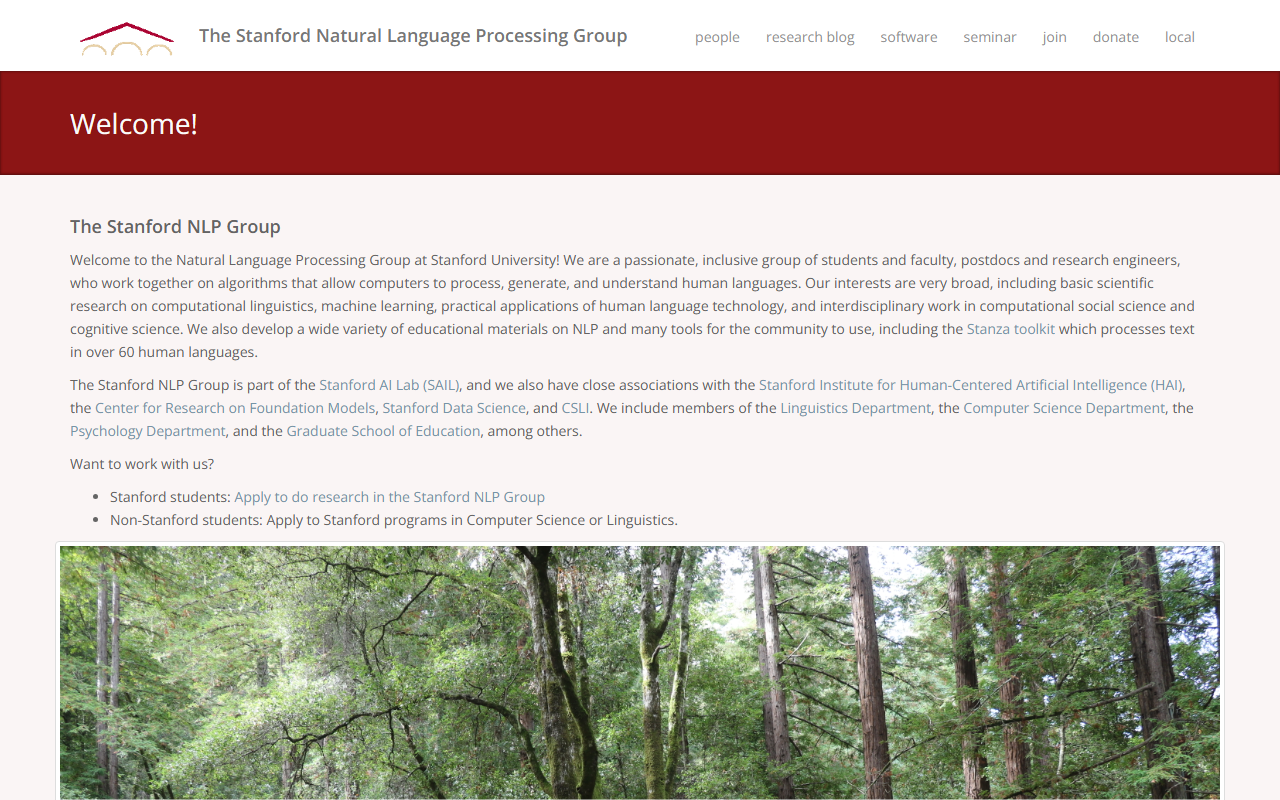
Upon visiting the Stanford NLP Group's website at nlp.stanford.edu, I was greeted with a clean academic landing page. The site serves primarily as a portal for the group's research, educational materials, and software releases. Unlike commercial AI tool dashboards, there is no sign-up form or API key generation. Instead, the focus is on open-source resources for the NLP community. The most prominent tool highlighted is Stanza, a neural pipeline that processes text in over 60 languages, covering tokenization, part-of-speech tagging, dependency parsing, and named entity recognition. The group also maintains CoreNLP, a Java-based suite, and a growing collection of educational resources. For developers and researchers, this is a treasure trove of battle-tested algorithms.
Testing the Tools: Stanza in Action
When testing the free tier—and everything here is free—I dove into Stanza's Python library. I installed it via pip and ran the pipeline on a sample sentence: 'Stanford University is located in California.' The default English model processed it in under a second, accurately identifying entities, syntactic dependencies, and lemmas. What impressed me most was the multilingual support. I tested the same pipeline on German and Japanese text, and while loading larger models took slightly longer, the accuracy remained high. The documentation on the site guides you through installation and usage, though it assumes you're comfortable with Python and command-line tools. There is no web-based GUI for interactive testing, which limits casual exploration but aligns with the developer-focused design.
Technical Details and Integration
Stanford NLP Group's tools are built on top of neural networks and transformer architectures, with Stanza using a BiLSTM and CNN-based model. The software is entirely open-source under the Apache 2.0 license. Unlike commercial alternatives like spaCy or Hugging Face's Transformers, there is no managed cloud API or paid support tier. Researchers and engineers must self-host the models on their own infrastructure. The tools integrate well with Python, Java (CoreNLP), and include pre-trained models for a wide array of languages. The group also provides pre-packaged models for specific domains, such as biomedical text, and offers APIs for training custom models using their framework. For any developer building multilingual NLP systems, this is a solid foundation—assuming you have the hardware to run large models locally.
Conclusion and Recommendations
Genuine strengths of the Stanford NLP Group's offerings include zero cost, broad language coverage, and rigorous academic backing. The models are well-documented and have proven reliability in research and production settings. However, there are real limitations: no cloud-hosted API, minimal community support outside academic forums, and a steep learning curve for non-developers. The tool is best suited for NLP researchers, data scientists, and engineers who need a free, high-quality multilingual pipeline and are willing to handle deployment themselves. If you prefer easy-to-integrate cloud APIs with managed infrastructure, consider alternatives like Google Cloud Natural Language or AWS Comprehend. But if you value academic transparency and want to run state-of-the-art NLP models on your own servers, the Stanford NLP Group is an excellent choice. Visit Stanford NLP Group at https://nlp.stanford.edu/ to explore it yourself.













Comments