

First Impressions and Core Offerings
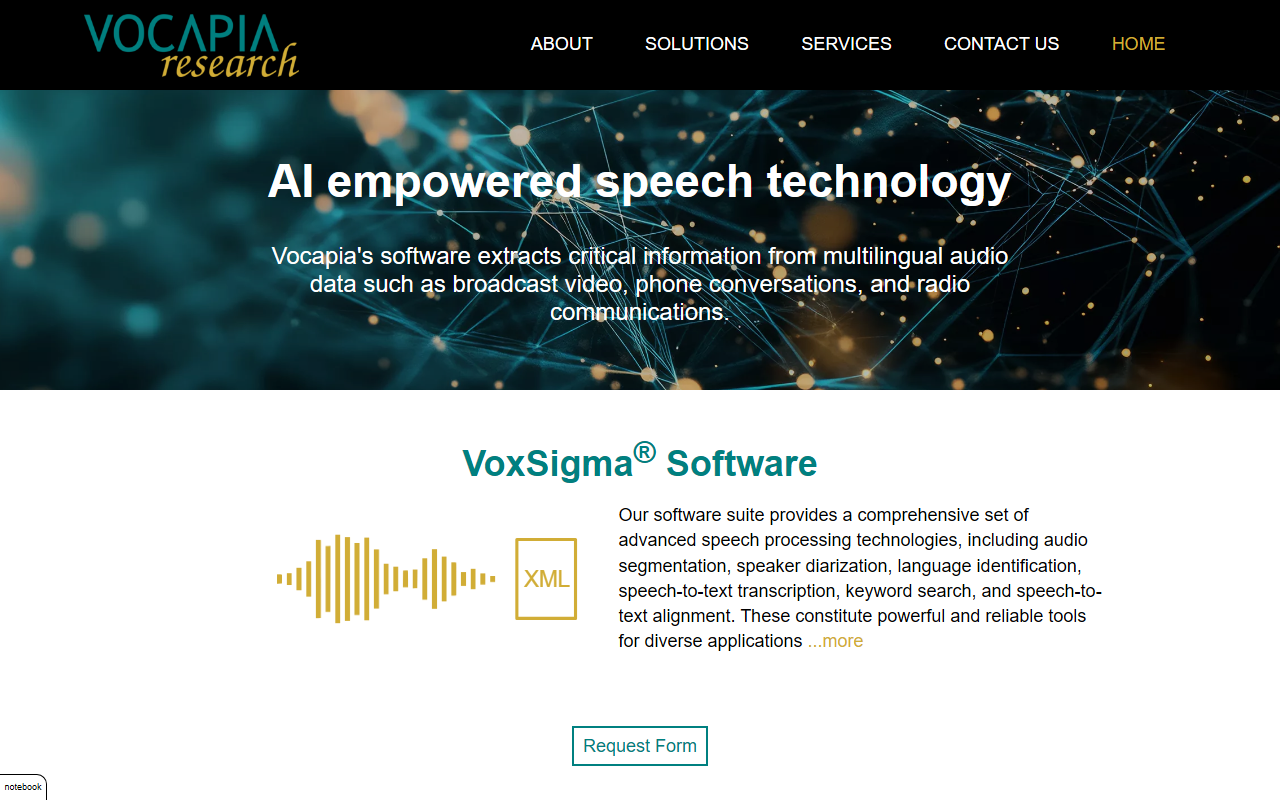
Upon visiting Vocapia’s website, I immediately noticed the emphasis on enterprise-grade, specialized speech processing. The site is clean but packed with technical detail, hinting at a tool built for professionals, not casual users. The headline — “AI empowered speech technology” — is followed by a clear statement: “Vocapia's software extracts critical information from multilingual audio data such as broadcast video, phone conversations, and radio communications.” This sets expectations for deep, customizable transcription and analysis capabilities.
The dashboard (or rather, the solution pages) list five core components: VoxSigma software suite, which includes audio segmentation, speaker diarization, language identification, speech-to-text transcription, keyword search, and speech-to-text alignment. These are not just buzzwords; each module is described with specific workflows. For example, the language identification module covers 100 languages and dialects, and clients can create custom language sets. The speech-to-text transcription boasts support for over 30 languages, including Arabic, Cantonese, Czech, English, French, German, Hebrew, Hindi, Mandarin, Pashto, Persian, Polish, Portuguese, Russian, Spanish, Swahili, and Ukrainian, among others.
When testing the literature on the website, I observed that the use cases are not generic. They dive into plenary and meeting transcription (for administrative hearings), avionics (cockpit command and communication analysis), VHF/UHF communications (military and ATC), telephone speech analytics, transcription of business conference calls, broadcast monitoring and audio-visual archive indexing, and audio communication analysis for tactical situational awareness. This reveals a clear focus on mission-critical, low-latency, and often security‑sensitive environments.
Technical Capabilities and Integration
Under the hood, Vocapia appears to use its own proprietary machine learning models, trained on specific acoustic environments. The site mentions they “exploit AI methods such as machine learning” but does not specify a particular base model (such as DeepSpeech or Whisper). However, given the claimed performance in the Airbus ATC challenge (where they ranked first), their custom models for VHF/UHF communications likely fine-tuned on noisy, narrowband radio data.
The software is available in three deployment models: on-premise licensing, REST API web service, and a GUI service for smaller batches. For developers, the REST API is the clear entry point — it supports batch processing, multichannel audio, and multilingual documents. The on-premise option is particularly attractive for organizations with data residency or security requirements. I also noted they offer a customization service to adapt models to “your specific requirements,” which is a major differentiator from off-the-shelf APIs like Google Cloud Speech-to-Text or AWS Transcribe.
In terms of integrations, Vocapia outputs structured XML and supports downstream processing for “content-based information access.” This is ideal for media monitoring companies or defense agencies that need to feed transcriptions into analytics pipelines. However, unlike consumer-focused tools such as Otter.ai or Rev, there is no user-friendly web app for occasional transcription — the emphasis is on high-volume, professional use.
Pricing and Market Position
Pricing is not publicly listed on the website. Vocapia’s site lacks a straightforward “Pricing” page, and all inquiries must go through a contact form or request. This is typical for enterprise B2B speech solutions. Based on the description — on‑premise licensing and per‑request API services — the cost is likely negotiated per project, based on language coverage, volume, and customization needs. For comparison, alternatives like Google Cloud Speech-to-Text start at $0.006 per 15 seconds of audio (for standard models), while Azure Speech Service charges $0.70 per hour for real-time transcription. But neither offers out‑of‑the‑box models for VHF/UHF military communications or avionics.
Who should consider Vocapia? It is best suited for defense contractors, intelligence agencies, avionics companies, large broadcast monitoring firms, and enterprises handling multilingual, noisy audio at scale. If you need to plenary hearings, process phone calls in 30+ languages, or integrate transcription into low-power aeronautical systems, Vocapia’s specialization is compelling. Conversely, if you are a solo podcaster or small business needing quick transcripts, you are better served by simpler APIs or consumer tools.
Strengths include: extremely broad language support, on‑premise deployment for security, specialized models for niche audio types, and a proven track record (ranking first in the Airbus ATC challenge). Limitations include: lack of transparent pricing, no self‑service sign‑up for the API, and a steep learning curve for non‑developers. The website does not offer a free tier or trial, which may deter smaller teams.
Overall, Vocapia is a serious tool for serious users. If your needs align with its specialized use cases, it is worth reaching out for a demo. For general-purpose transcription, look elsewhere. Visit Vocapia at https://vocapia.com/ to explore it yourself.













Comments